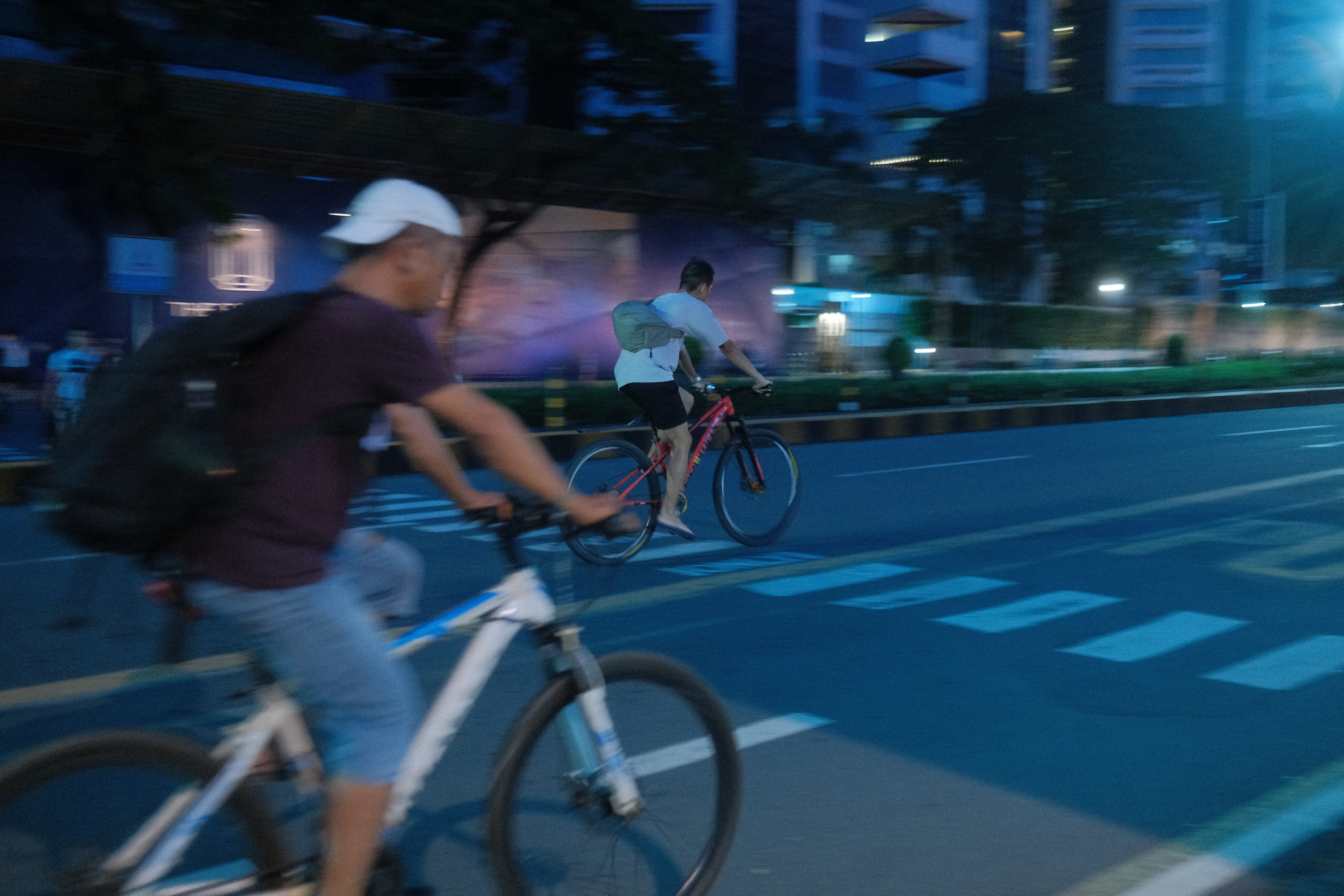
“Nag-bike ka lang?” (Did you just bike here?)
It’s normal for people to say “Hi” after seeing each other at a gathering. In my case, that’s almost always followed by the question above. I understand they mean no malice in asking.
However, statements like that have a deeper implication about the perception of bike commuting. The little things like a simple “lang” can show how people look down on transport cyclists.
Language matters. At the lightest, people exhibit a strange fascination—like seeing a fish walk on water. At the worst, it cuts sharply like a knife and severs connections among friends and family.
Objectively speaking, no single mode of transport is inherently superior to the others. It’s just that some are more efficient and practical, depending on the situation. The problem is that car-centrism is deeply rooted in our culture, and it seeps through in the words we use in regular conversation.
Language matters because it is the means by which we communicate ideas, and ideas shape our everyday reality. When bicycles aren’t part of the picture, so are the people who use them.

Exclusionary street design hinders bike commuting
The one thing that’s almost as bad as anti-cycling regulation is exclusionary street design and infrastructure. You may not be prohibited from riding a bicycle. But because there is no regard for bike commuting, your destination might not be accessible. Entertainment City is a prime example for me.
Even with my years of experience with bike commuting, cycling to a place like Solaire never made more sense to me than driving. The route is inhumane, for there’s no good choice: take the Magallanes flyover, climb up and down the stairs at the park below, or pass through the congested roads near the airport.
Despite the large, multi-level parking buildings, there’s still no place for bicycles. You’ll feel like a fish out of water navigating through these massive labyrinths. And since there are no proper bike racks, there’s no choice but to park like a motorcycle and hope that the bike is still there when you leave.
The hindrances don’t stop since the management of posh places tends to treat bike commuters with apprehension. “Ano sadya mo?” (What business do you have here?) I might have to go through an interrogation before I can even get to the bathroom and change clothes.
Going bimodal doesn’t sound so feasible, too. I could take the MRT or the EDSA Carousel to Taft or MOA, respectively. But the surrounding streets (such as J.W. Diokno, Diosdado Macapagal, and ASEANA Avenue) are wide, multi-lane stroads with fast-moving vehicles.
I also thought that applying for Okada membership and using the shuttle from SM Megamall would come in handy. But I couldn’t bring myself to trust that the service is reliable, especially when I have to be punctual and fresh for more formal events.
When bike commuting strains relationships
The most painful moments are when language is weaponized against bike commuting. There are many problems in the world, but the most pressing one at the dinner table is my choice of mobility.
I’ve never faced more contention in life than with my choice to ride a bicycle. It’s reached a point where family members plead with me not to do bike commuting, as if I were a suicidal maniac for doing it.
They don’t think cyclists belong on the road, so they feel unjustly burdened when they have to extend consideration and courtesy for the safety of vulnerable road users. They even resort to victim-blaming, not realizing that they contribute to the risks I face on the road whenever they drive their cars.
Suddenly, there’s a moral gravity to bike commuting. And if I insisted on my way, I’d be considered a defiant son.

Ignorant language harms bike commuting
“Dapat nasa gilid ka lang.”
“Hindi dapat nasa kalsada ang mga bisikleta.”
“Bawal gumitna ang mga siklista.”
“Paano ka pupunta, walang bike lane doon?”
Statements like these aren’t just false, they also enforce the micro-aggressions people experience on the road when bike commuting, especially when perpetuated through social media. It’s alarming when ordinary people act like psychopaths just because they’re behind the wheel.
Combine this with how crashes are referred to as “accidents,” and any sense of accountability or dignity is thrown out of the window. The lost lives are reduced to mere numbers and statistics.

Words as the building blocks for advocacy
Speaking up for bike commuting is challenging, especially when there’s so much hostility on social media. We need to be patient and remember that we’re all just people who want to get around. No one is ultimately defined by their mode of transport.
Cars aren’t evil. But car-centrism is, in the sense that it separates people—physically and relationally.
There is no immediate solution to end it. But what we can do is to continue advocating and fighting for our space, both on the road and in the culture.
Words alone aren’t enough, but they are foundational in achieving the change that we want to see. That’s why inclusive and people-first language is essential.


