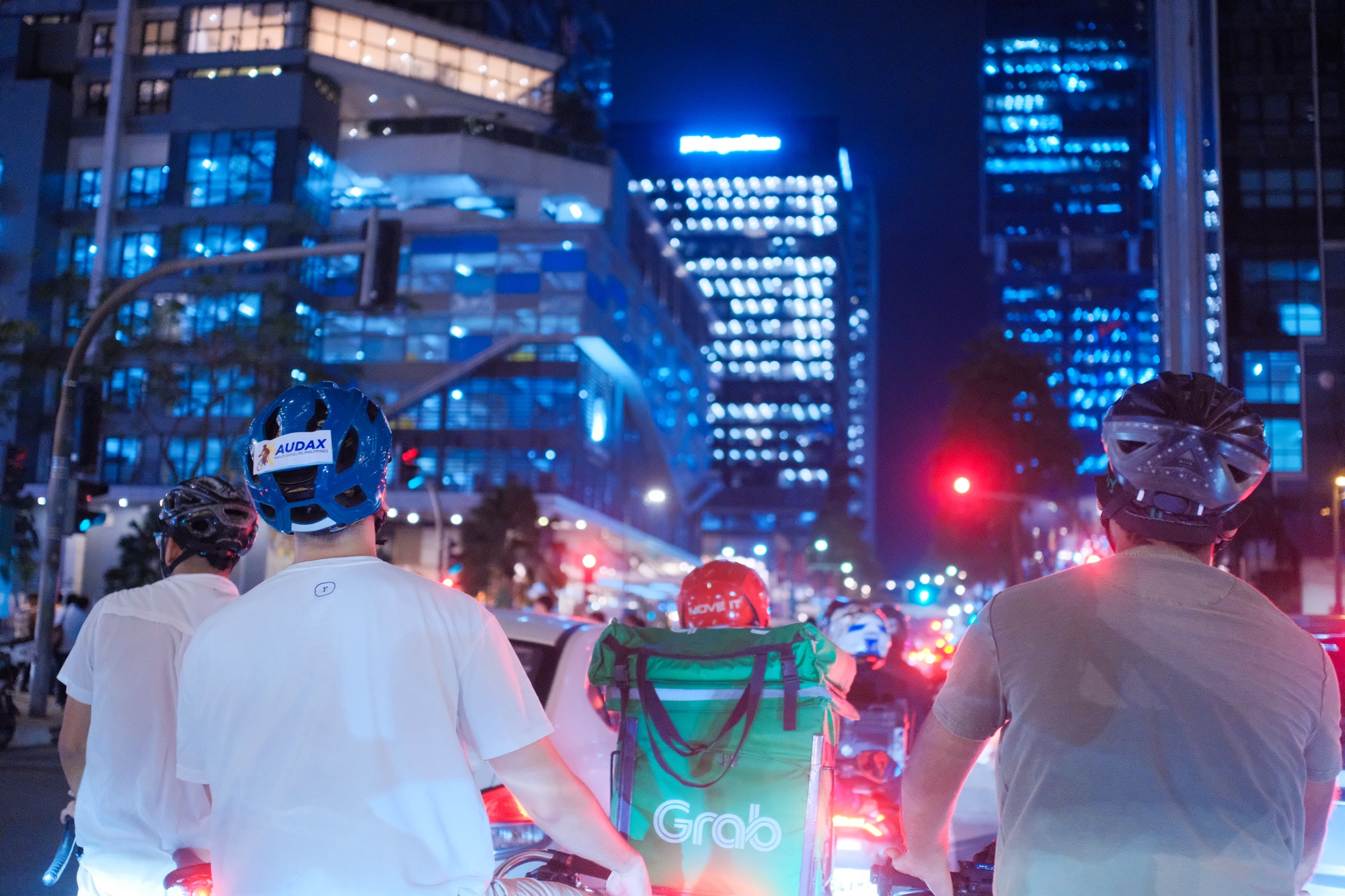
Bike commuting in Manila is generally fun and more efficient than being stuck in a car amid traffic, especially along EDSA. Of course, though, we do have to deal with errant drivers who don’t always pay attention. But what if you’re a foreigner unfamiliar with the unwritten rules of commuting in the metropolis?
Through Leandro (who also contributes to Visor), I met Gunjit and Milo from Sciences Po, a research university based in Paris, France. They visited Manila to interview thought leaders from the bike-commuting community for their research project, and during our conversations, we encouraged them to try bike commuting during the afternoon rush hour from Pasig to Makati. The whole trip was just over 16 kilometers, covering major thoroughfares such as Shaw Boulevard, EDSA, Ayala Avenue, and parts of BGC. Leandro led the group, while I did sweep duties.
Filtering is the Name of the Game

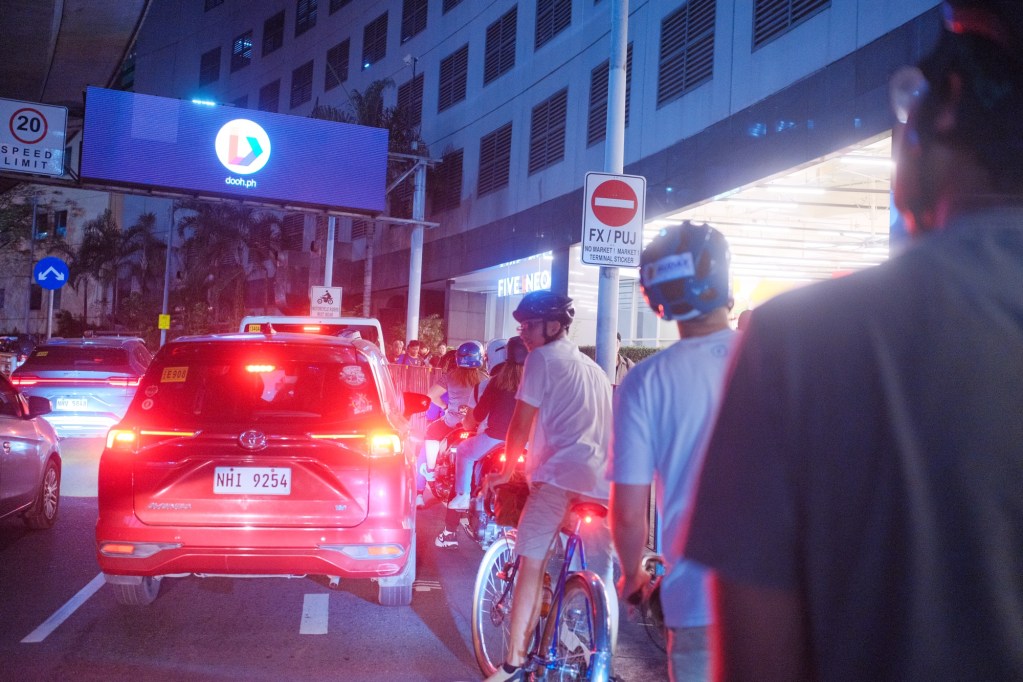
Given that we rode out a little past five in the afternoon, we expected moderate to heavy congestion, especially along Shaw, where the road narrows as it approaches EDSA. As well, cars and motorcycles try to squeeze into whatever space they can find just to get ahead of the vehicle in front of them. Gunjit and Milo observed that, even when there are clear markings for bike lanes, these are not always honored or respected. So when there’s a horde of motorcycles taking up the space on the bike lane, we had to filter out, either by going onto the sidewalk or going into the inner lanes.
We don’t think about it often when bike commuting in Manila, but filtering is a skill bike commuters learn to claim their space on the road, especially when their own dedicated space has been encroached by others. It’s a life-or-death decision-making process that happens in seconds, where you need to take into consideration every road user’s body language, anticipate movement, and assert enough presence to stay visible without escalating tension.
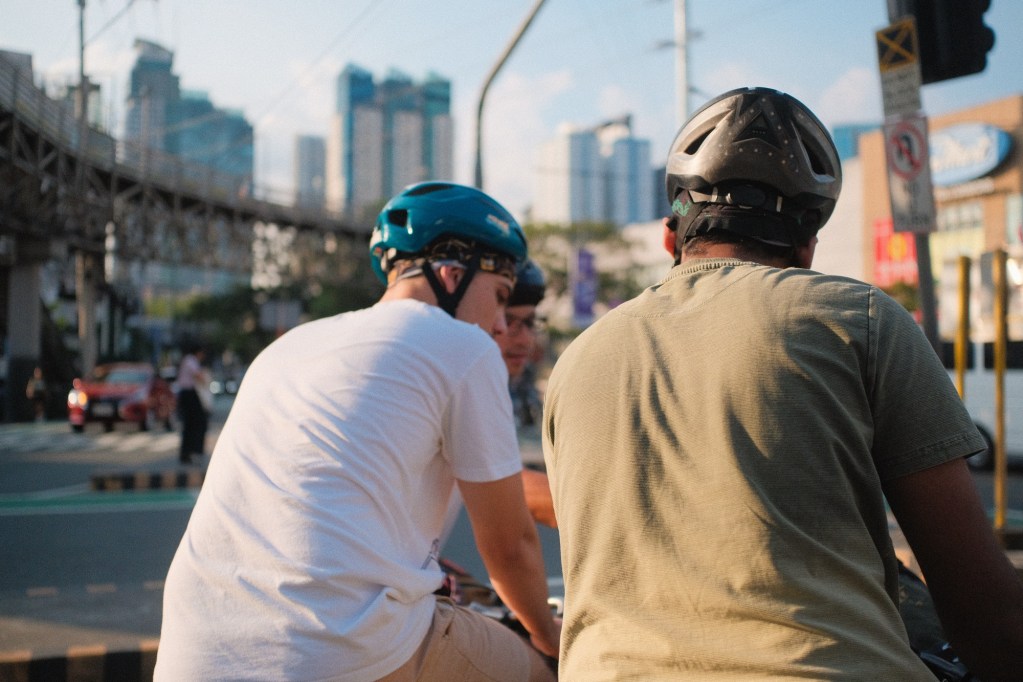
Once on EDSA, though, we mostly kept to the right side of the road as we made our way toward Makati. It was a predictable ride until we reached the EDSA-Estrella section, where barriers had been put up for DOTr’s “rehabilitation” works. So we encountered a sudden gravel trail leading up to Ayala Avenue. Thankfully, though, our tires can easily take on a few loose rocks.
We took a break and had an early dinner at Panco in Legazpi Village.
The group decided to head back to Pasig through a different route: instead of taking McKinley Road and navigating BGC, we exited Ayala Avenue and made a turn to EDSA northbound. We took a right onto Kalayaan Avenue to make our way to BGC. Given that we were still biking in the midst of rush hour, we had to filter in and out of the bike lane.

The final leg of our commute brought us to Barangay Pineda, a highly pedestrianized part of Pasig City along the Pasig River. It was a stark contrast from the busyness and hazards of EDSA traffic; people, especially children, were out in the streets, and bike commuting took a slower pace.

Cultural Differences
Riding with Gunjit and Milo reinforced something we already knew: bike commuting in Manila isn’t just shaped by infrastructure and road design, but also by culture.
For Gunjit, what feels normal is often just a reflection of how risky conditions have been normalized.
“I have driven a motorbike in Delhi,” Gunjit said, “and it’s the same situation. Maybe not as unsafe as cycling… but [learning to find] those nooks and crannies and the art of looking back in half a second… feels pretty normal.”
Milo, on the other hand, bikes around Paris, where bike lanes are respected, and lanes are clearer.
“I needed time to adapt,” Milo shared, “I had to learn more or less what was the place of the bike in these streets. What amazed me is that bike lanes do not serve much purpose here compared to Paris.”
What stood out for them was how much communication happened between us and other road users. Bike commuting in Manila means using your body as much as your bike, be it exaggerating movements or making loud sounds. For most of us seasoned bike commuters, it is what it is… unfortunately.
We Need to Claim Our Space

Their experience ties everything back to their interview with me the day before: what did I mean when I said ‘Claim your space‘?
Bike commuting in Manila almost always means having to assert ourselves and occupy space as quickly as we can. This aggression is done out of necessity. We all want to get to our destination safely. We have to constantly read the road and make split-second decisions to hesitate less, because that’ll put us at greater risk. It might mean occupying the middle of the bike lane when a motorcycle tries to slip through, or putting your hand out to indicate you’re turning left so that cars won’t speed by.
Other road users may be responding to their own pressures, but it is unfair that the burden of safety often falls on the vulnerable road user, such as the cyclist, to assert that space clearly.
It’s the opposite in Paris, where space is protected and respected. On our roads, it’s like a raging river: fluid and chaotic. So if you don’t claim your space, someone else will take it.
I hope Gunjit and Milo made it to Paris with a clearer understanding of what it means to be a bike commuter in Manila, and what it takes to claim one’s space in a system that doesn’t always want to make room for you.


Leave a Reply