You and I are commuters, from the moment we step out of the house to the time we head back home. So our commutes should be convenient, affordable, and safe. But our collective experience says otherwise.
With participatory transport planning, our voices must be heard.
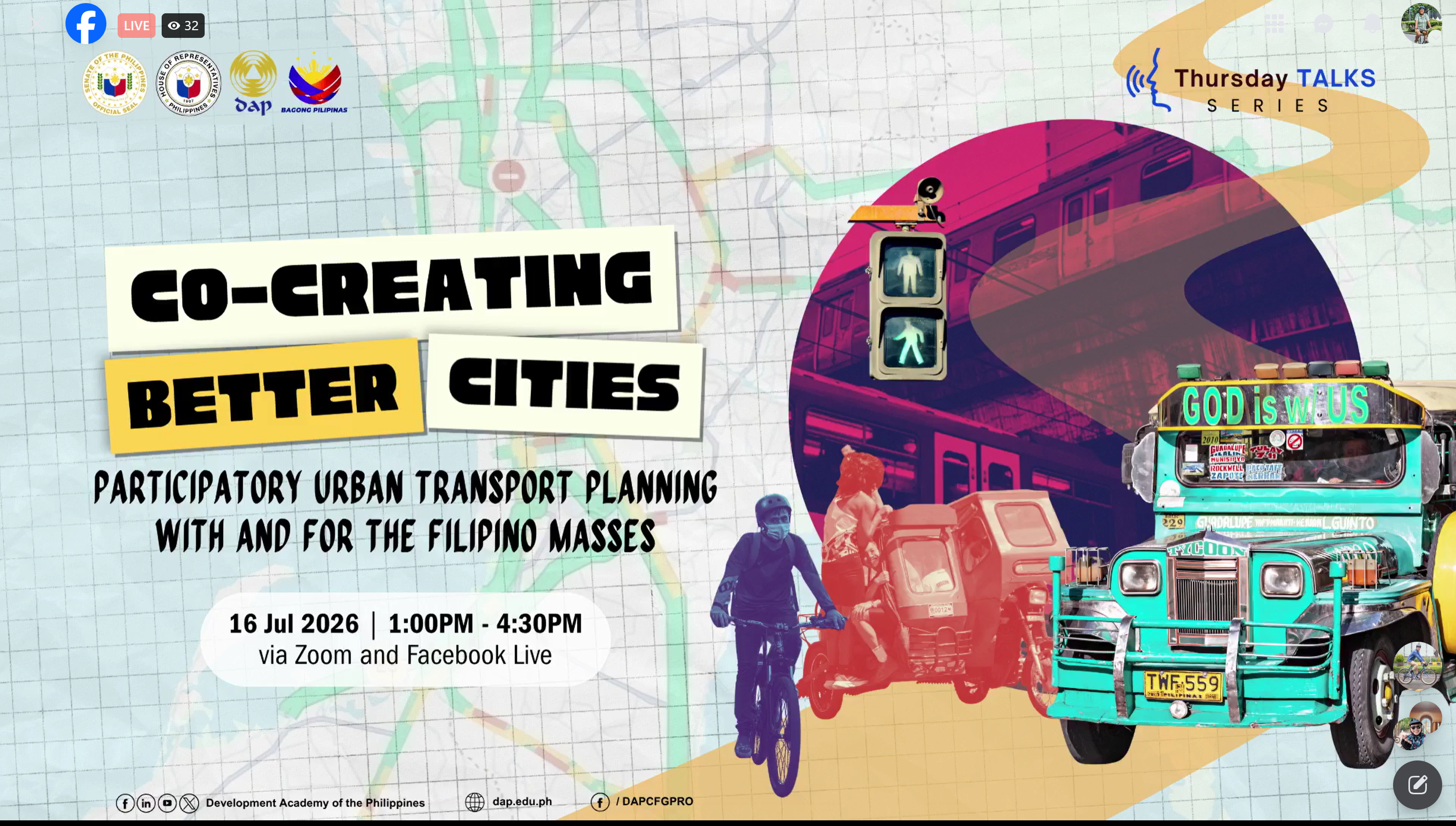
On July 16, 2026, the Development Academy of the Philippines held a series of discussions under Co-Creating Better Cities: Participatory Urban Transport Planning with and for the Filipino Masses. Members from national government agencies and the private sector joined through Facebook Live and Zoom.

The moderator and speakers have all identified that “urban transport is not about cars or roads, but about people,” and that the powers that be should rethink the role of the Philippine commuter when it comes to urban mobility.
Participatory Transport Planning for Better Policymaking
Participatory transport planning is an approach in urban design in which planners involve people who use various transport infrastructure. With technical data and lived experiences combined, they design roads based on their needs and habits. It negates the archaic belief that if “you build it, they will come,” and shifts the commuter’s role from a statistic to an active co-designer of how the city moves.
Throughout the talk, participatory transport planning was an evident theme, as each speaker mentioned that this approach can provide a better way to provide safer and more equitable transport legislation.
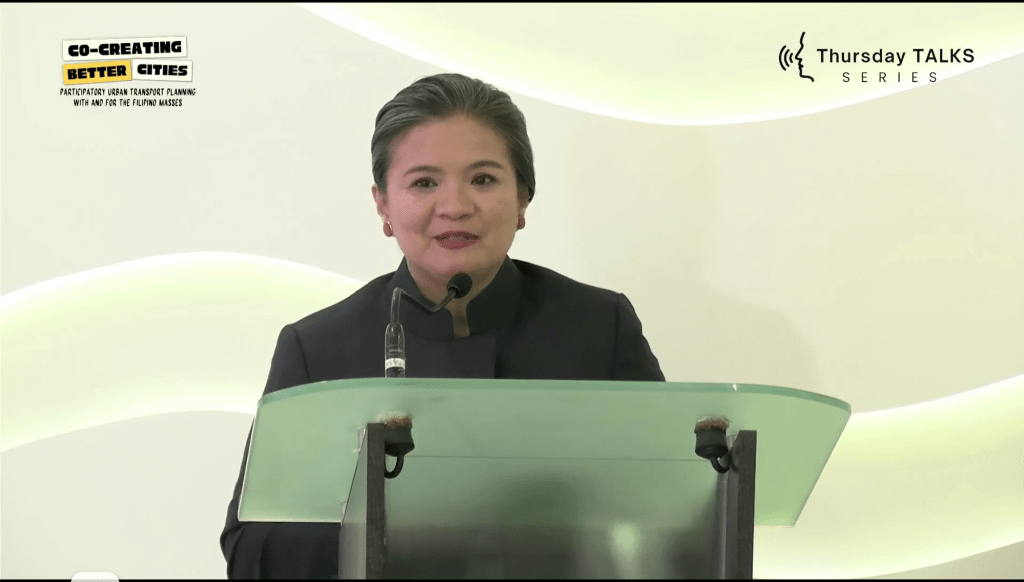
In her presentation, Dr. Danielle Marie Guillen from the UP Asian Institute of Tourism emphasized that Metro Manila’s acute mobility crisis cannot be solved by traditional engineering models alone, as these tools fail to capture the lived experiences of the people. She cites that commuters lose 105 hours annually to traffic and face severe safety risks, and that one person dies every 15 minutes from a road incident.
True human-centered mass transit requires treating the diverse commuting public as the ultimate system experts rather than mere statistics. To bridge persistent structural, administrative, and political feedback gaps, government planning must evolve from mere token consultation to genuine collaboration. She used localized models like the Iloilo Active Transport Master Plan and other foreign case studies that co-designed smart, caring, and equitable neighborhood-level mobility from the ground up.
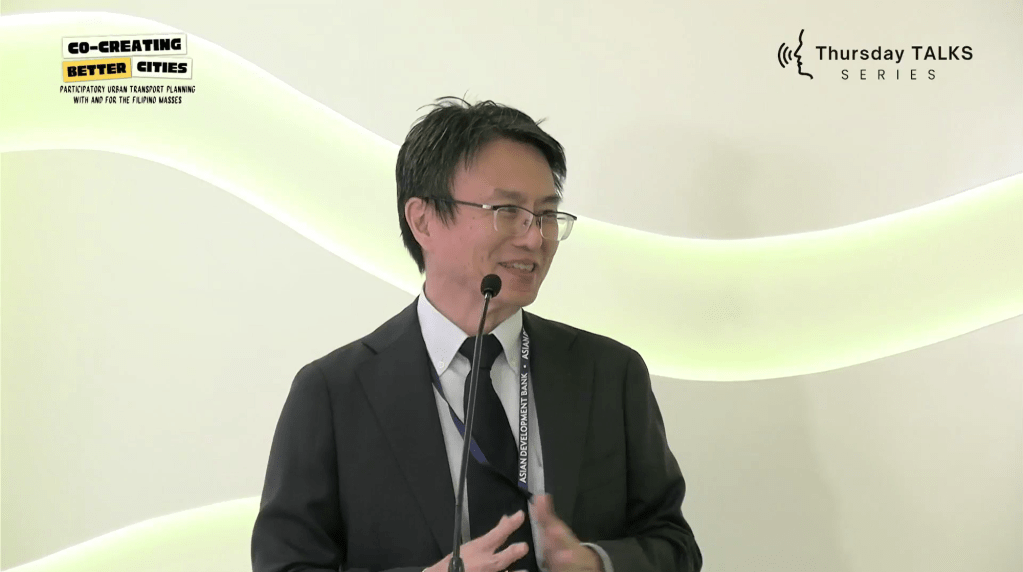
Building on the premise that lived experience is high-value data, Shuji Kimura from the Asian Development Bank emphasized that meaningful stakeholder engagement must go beyond tokenism by integrating commuters across the entire project lifecycle, from initial master planning and feasibility studies to technical design and final implementation.
Moving away from “infrastructure provision” to active “service delivery” requires consistent public engagement, as demonstrated by Tokyo’s Outer Ring Road (ORR) Expressway project and the Niigata Bus project. Both projects show that planning is not a rigid template. Rather, it succeeds when planners remain flexible enough to let public feedback reshape the physical design and final routes.
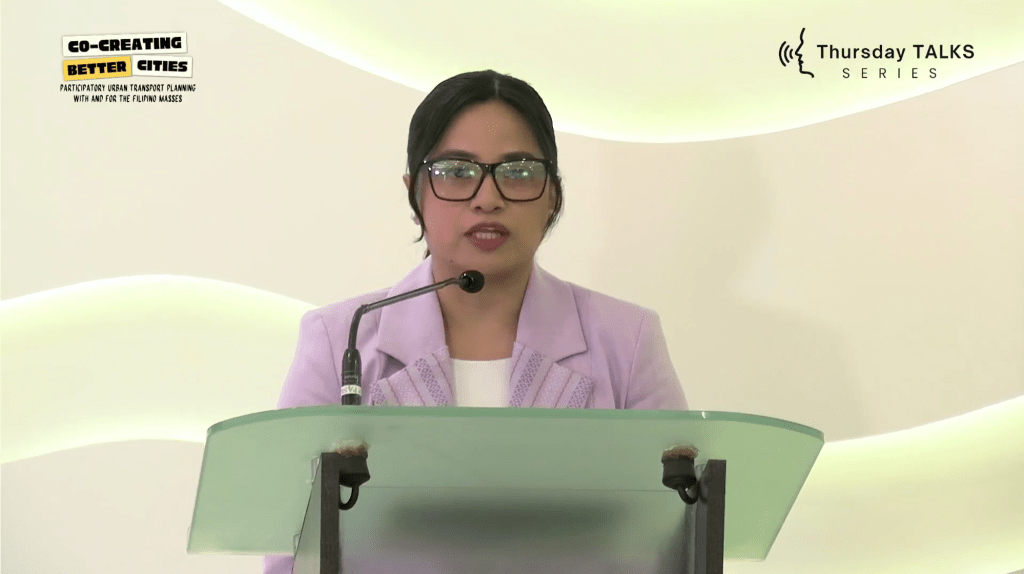
Nezza Mendoza, Service Director of the Department of Transportation (DOTr), recentered the discussion on the humanity of commuting, asserting that “transportation is about people.”
To move beyond tokenism, Mendoza outlined a concrete strategy to genuinely integrate public voice into policy:
- Institutionalize stakeholder engagement so it becomes a standard legal and bureaucratic mandate
- Listen through multiple active channels, such as directly consulting active transport groups on initiatives like the Active Transport Strategic Master Plan (ATSMP)
- Convert raw feedback into better executive decisions
She framed this relationship as an ongoing, circular process:
- Listen by engaging stakeholders early and continuously throughout the policy lifecycle
- Learn by actively balancing rigid technical data with the qualitative lived experiences of commuters
- Improve by continuously refining policies, programs, and service delivery based on those insights

Alyanna Mae Bernadette from the Quezon City Traffic & Transport Management Department (TTMD) argued that local mobility planning must prioritize how humans navigate space rather than how vehicles move.
Her presentation identified critical gaps in current LGU processes for participatory transport planning, pointing out the issues of one-time public consultations, limited stakeholder representation, and a tendency to drop feedback loops once a project is done. She also added that community voices must be what actively shape a plan’s vision, and data should validate those priorities, citing initiatives like the QC Bus and bike lane network as examples.
She stressed that participation should not just be one step in the plan, but as a necessary part of entire process (overlapping her thoughts with Kimura’s). She highlighted that in a living urban ecosystem, “the work is never finished.”

Closing the panel, Patricia Mariano, Director and Co-Founder of AltMobilityPH, brought the discussion to the fundamental human right to move. She argued that a lack of safe, reliable public transport systematically strips citizens of access to education, fair employment, and healthcare.
She argued that mobility is a right, governed by the inverted priority pyramid that places people outside of cars at the absolute top of urban design, ahead of private vehicles. She emphasized that every commuter has the right to affordable and dignified mass transit, a fair share of public road space, and clean air while traveling, among others, as detailed in the Magna Carta for Commuters.
In the end, Mariano challenged planners and policymakers to make a shift in mindset: to design the city, you must think of the commuter, while thinking like a commuter.
Participatory Transport Planning must be Guided by Empathy

In the dozens of discussions I’ve attended as a road safety advocate, the message is the same: build with empathy. The speakers today said that in so many words. Sadly though, it often needs repeating.
Empathy is the realization that everyone, from the nurse taking the jeepney to the city’s general hospital to the transport cyclist getting to work in Makati, is paying with their lives just to get to wherever they need to be.
If we truly want to build smart and caring cities, we have to stop designing our roads for private vehicles and start designing them to safely transport human lives with dignity and equity. Participatory transport planning proves that those who survive the daily commute are the very ones who hold the blueprints to rebuild the road ahead.


Leave a Reply